A Semiotic and Psychoanalytic Reading of La Trahison des Images
“A day will come when, by means of similitude relayed indefinitely along the length of a series, the image itself, along with the name it bears, will lose its identity.”
Michel Foucault, This Is Not a Pipe1
Introduction
In the artistic context of the 1930s, René Magritte emerged as a crucial representative of Belgian Surrealism, meticulously extracting the nuanced relationship between language and image from traditional visual frameworks and prominently presenting it to the public. In subsequent years, this theme became the core focus of his artistic exploration. As early as 1929, while creating illustrations for the Surrealist magazine La Révolution Surréaliste2, Magritte demonstrated a heightened attention toward linguistic forms—not merely employing words as rhetorical ornaments within pictorial compositions, but actively questioning the dominant position language holds within cognitive systems.
In my point of view, Magritte’s painting of the same year, La Trahison des Images (1929, figure 1), perfectly encapsulates his distinctive interpretation of visual images and textual language. His iconic declaration, “Ceci n’est pas une pipe,” continues to be extensively discussed and cited across both artistic and philosophical discourses even today.

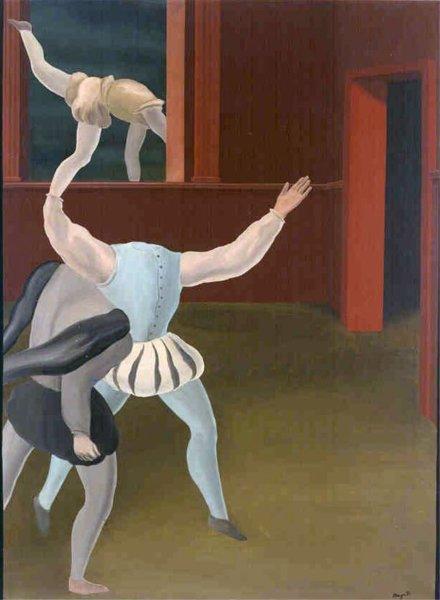
Magritte’s early works predominantly consisted of abstracted representations of figurative imagery influenced by Cubism—such as Self Portrait (1923,figure 2)—or compositions of dreamy ecstasy, as in The Birth of Idol (1926, figure 3) and A Panic in the Middle Ages (1927, figure 4). I maintain that La Trahison des Images marks not only a significant turning point in Magritte’s individual artistic language but also represents a profound intervention into systems of signification. By juxtaposing the realistically rendered image of a pipe with a linguistic negation of its identity, Magritte interrupts the arbitrary logic of language, thereby leading the viewer into a cognitive paradox: a visual depiction unequivocally presents a pipe, yet the accompanying descriptive text resolutely negates this identification. This experiment vividly exemplifies semiotic theory in practice. The tension between language and image elevates the work beyond mere expression within a single medium, situating it firmly within the deeper structural workings of signification.


La Trahison des Images isn’t merely a paint on canvas, but an intellectual experiment—an effort to deconstruct and reconstruct the interrelations of language, image, and meaning. In this paper, drawing from semiotic and psychoanalytic perspectives, I will explore how Magritte’s visual strategies reveal the boundaries between language and representation.
Saussure and Peirce
Language, unlike vision, cannot reproduce its object—it cannot present it directly before our eyes. Rather, it can refer to an object, describe it, and guide the reader toward associations of its form and meaning; yet the image, as the very face of the subject, remains concealed. In Ferdinand de Saussure’s linguistic theory, a sign is composed of a dual structure: the signifier and the signified.3 Applying this theory to La Trahison des Images, we may consider the pipe depicted in the image as the signifier—that is, the physical appearance of the image, the form rendered in paint. The concept evoked by the word “pipe”—a tool used for smoking—is the signified. Magritte disrupts the reader’s habitual association of “image equals object” through the inscription “Ceci n’est pas une pipe” (“This is not a pipe”). He reminds us that the pipe in the painting is merely an image of a pipe, not an actual pipe. This work, therefore, compels the viewer to recognize that the image, as signifier, is not equivalent to the real object it signifies. It is a representation, not a reality.
Different from Saussure’s binary structure, Charles Sanders Peirce’s semiotic theory accounts for the influence of contemporary cultural and social dimensions, classifying signs into three basic types: icon, index, and symbol.4 In La Trahison des Images, the painted image of the pipe can be identified as an icon, as it bears a high degree of visual resemblance to a real pipe in terms of form and appearance. However, the image in this work is not indexical; the accompanying text—”Ceci n’est pas une pipe”—functions instead as a symbol, relying on the conventions of the French linguistic system for its meaning. Through the juxtaposition of these two types of signs, Magritte generates a semantic tension: the image and the text appear to convey the same message, yet they contradict one another. The painted pipe, composed of color fields and lines, bears no direct causal relationship to the real, wooden object it evokes. In other words, it is not the trace or imprint of an actual pipe, but rather a reproduction confined to the realm of representation.
Magritte once remarked, “And yet, could you stuff my pipe? No, it's just a representation, is it not? So if I had written on my picture ‘This is a pipe,’ I'd have been lying!”5 This insistence on the distinction between image and object may be understood as a critical interrogation of the relationship between seeing and trust in modern society. Whether linguistic or visual, neither system suggests direct access to “reality.” Both are elements within a network of signs—mediating tools through which we attempt to comprehend the world.
Foucault and Barthes
From the painting, it is evident that Magritte disrupts the representational triad of word–image–object. The pipe depicted in the image cannot be smoked—it is not the “object” of the real world. The text negates the authenticity of the image, while the demonstrative pronoun “ceci” (“this”) hovers ambiguously between language, image, and viewer, generating a slippage of meaning. In the begining of The Order of Things, Michel Foucault references Magritte’s painting to support his argument that there exists no direct correspondence between image, language, and reality.
Foucault argues that principles of resemblance (visual representation) and affirmation (linguistic representation) fidelity governed the visual logic of painting6 by binding the act of seeing to the act of naming. La Trahison des Images, however, radically breaks with this regime of representational identity. Magritte replaces resemblance with similitude7—a looser, less regulated form of likeness that resists fixed reference. Through this gesture, Magritte denies the truthfulness of the image, while simultaneously undermining the authority of language by using text to identify the image only to negate that identification. In doing so, he deconstructs the habitual mechanisms by which vision and language are cognitively aligned. Once the organizing order and focal clarity imposed by selective resemblance are stripped away, the object reverts to the chaotic, multidirectional openness of lived experience. As Foucault writes in This is Not a Pipe, “the image itself, along with the name it bears, will lose its identity.”8
This relationship between image and text, caught in a process of dissolution, also finds resonance in Roland Barthes’s theoretical framework. Viewed through Barthes’s lens, La Trahison des Images is not only a denial of visual reproduction in relation to reality, but also a dissolution of both “authorial intent” and “textual fact,” contingent upon shifting contexts and interpretive subjects. The visual sign here ceases to function as a transparent conduit for the author's intended meaning and becomes instead an open field of interpretation, where meaning is actively produced by the reader. As author, Magritte withholds definitive interpretation, consciously withdrawing to allow the tension between language and image to ferment on its own. The image of the pipe is not a declarative statement issued by the artist, but rather a text—one that demands the viewer’s participation in its interpretation.
Barthes and Foucault thus extend the semiotic analyses of Saussure and Peirce by introducing questions of subjectivity, authorship, and the mechanics of viewing. To pursue this trajectory further is to enter the domain of psychoanalysis.
Psychoanalysis
Jacques Lacan divides the subject’s experience into three registers: the Imaginary, the Symbolic, and the Real.9 The image of the pipe in La Trahison des Images belongs to the Imaginary—it offers a coherent, unified form with which the viewer may identify. In contrast, the inscription “This is not a pipe” emerges from the Symbolic order, representing the intervention of the social-linguistic system. This symbolic utterance disrupts our identification with the image, shattering the illusion of wholeness and coherence. As a result, we are compelled to confront the Real—that which resists symbolization, the void of meaning that cannot be fully grasped through either language or image. The disjunction between text and image in La Trahison des Images thus exemplifies, within Lacanian theory, the effect of linguistic and symbolic structures on the formation of the subject. It is through this rupture that the impossibility of full meaning—the absence at the core of signification—becomes manifest.
The subject comes to recognize the irreconcilable gap between visual appearance and linguistic articulation—a tension made manifest in Magritte’s painting. The subject is caught in a state of division between the chain of signifiers and the realm of imaginary identification, unable to fully grasp either the nature of their desire or the Real. In the act of viewing La Trahison des Images, the observer may initially accept the pipe’s visual representation without hesitation, identifying it as a real, concrete object. This mirrors the process described by Lacan in his theory of the mirror stage, wherein the infant’s recognition of the self in the mirror is based on an imaginary construction. The mirror image confers a sense of wholeness upon the “I,” yet in reality, the child’s corporeal and psychic existence remains fragmented and disordered. The illusion of unity is a product of the Imaginary, masking the instability that lies beneath10. As the viewer's gaze shifts downward and encounters the text “This is not a pipe,” a rupture occurs within the subject’s internal cognition. The linguistic intervention destabilizes the viewer’s initial misrecognition of wholeness: one realizes that what is being gazed upon is not a “real” pipe, but merely a representation—an image—and language, rather than affirming its existence, categorically denies it. This negation plunges the subject into the void of desire; the image of the pipe, which the subject longs to affirm as real, now becomes objet petit a—the elusive object-cause of desire. It is simultaneously present (we see it) and absent (it is denied).
Lacan defines desire as something one mistakenly assumes to be one's own—”a desire presumed to be one's own.” In reality, human desire is the desire of the Other, desire, in this framework, is not a conscious intention but an unconscious structure11. In other words, in La Trahison des Images, the objet petit a is not equivalent to the image itself, but rather to the “real pipe” to which the image refers yet can never attain. Here, object petit a functions as the lure of desire—it entices but never satisfies. The viewer’s desire for the “object” is constructed precisely within this misrecognition, where the imagined fulfillment is perpetually deferred.On this level, Magritte’s La Trahison des Images is not merely a philosophical exercise in visual paradox; it is a profound demonstration of how desire is produced, prolonged, and endlessly provoked in the interstices between image, language, and the Real.
Critical Reflection
This experience of seriously writing an analytical essay made me realize my own limitations in summarizing and articulating fragmented information, as well as the ways in which both semiotic and psychoanalytic approaches—due to their reliance on theoretical systems—can sometimes weaken the room of personal observation and judgment. As I review certain parts of my paper, I concern that some of my arguments might seem too theory-driven, with arguments and lack sufficient grounding in concrete visual evidence. However, given my personal interest in art history and philosophy, and considering the formative influence that both La Trahison des Images and Foucault’s This is Not a Pipe had on my aesthetic awakening, this opportunity to apply the theoretical frameworks of semiotics and psychoanalysis in a systematic analysis of an artwork was an immensely meaningful experience. I sincerely hope to have more opportunities in the future to conduct in-depth research on other artworks and areas of analysis that deeply interest me.
Notes
1 Foucault, Michel, René Magritte, and J A Harkness. This Is Not a Pipe. Berkeley, Calif.: University Of California Press, 2008. ↩
2 Richard Calvocoressi. Magritte. Translated by Wen Han. 1996. Reprint, Hunan Fine Arts Press, 2020. ↩
3 Hatt, Michael, and Charlotte Klonk. Art History : A Critical Introduction to Its Methods. Manchester: Manchester University Press, 2006. ↩
4 Hatt, Michael, and Charlotte Klonk. Art History : A Critical Introduction to Its Methods. Manchester: Manchester University Press, 2006. ↩
5 Torczyner, Harry, Richard Miller, and René Magritte. Magritte : Ideas and Images. New York: Harry N. Abrams, 1977. ↩
6 Foucault, This Is Not a Pipe. 2008, 34. ↩
7 Same as above. ↩
8 Foucault, This Is Not a Pipe. 2008, 54. ↩
9 Lacan, Jacques. Écrits : A Selection, “The Mirror Stage as Formative of the Function of the I as Revealed in Psychoanalytic Experience”. Translated by Qiong Wu. 1966. Reprint, London ; New York: Routledge, 2008. ↩
10 Chen, Qian. “Self-Gazing and Subject Construction in the Age of Images.” Radio&TV Journal 4 (December 2024). [Translated] ↩
11 Lacan, Jacques. Selection of Lacan. Translated by Xiaoquan Chu. Shanghai SDX Joint Press, 2001. ↩
Works Cited
[1] Foucault, Michel, René Magritte, and J A Harkness. This Is Not a Pipe. Berkeley, Calif.: University Of California Press, 2008.
[2] Richard Calvocoressi. Magritte. Translated by Wen Han. 1996. Reprint, Hunan Fine Arts Press, 2020.
[3] Torczyner, Harry, Richard Miller, and René Magritte. Magritte : Ideas and Images. New York: Harry N. Abrams, 1977.
[4] Lacan, Jacques. Écrits : A Selection, “The Mirror Stage as Formative of the Function of the I as Revealed in Psychoanalytic Experience”. Translated by Qiong Wu. 1966. Reprint, London ; New York: Routledge, 2008.
[5] Chen, Qian. “Self-Gazing and Subject Construction in the Age of Images.” Radio&TV Journal 4 (December 2024). [Translated]
[6] Lacan, Jacques. Selection of Lacan. Translated by Xiaoquan Chu. Shanghai SDX Joint Press, 2001.
[7] Barthes, Roland. Mythologies. New York: Hill and Wang, 1972.www.wikiart.org. “Rene Magritte,” n.d. https://www.wikiart.org/en/rene-magritte/all-works#.
[8] McEvilley, Thomas. “THIS IS NOT a PIPE.” Artforum, October 9, 1983. https://www.artforum.com/columns/this-is-not-a-pipe-207974/.
[9] http://www.wikiart.org. “Rene Magritte’s Work” https://www.wikiart.org/en/rene-magritte/all-works#.
Leave a Reply
Please log in with a free reader account to participate.